

With temperatures dropping and the late October sun fading, Forest Preserves of Cook County Police approached a tent at Dan Ryan Woods. A few minutes after Deputy Commander Jim Davis and Officer Adrian Nazar called in, a man unzipped the door and stepped out. With heartbreaking simplicity, he explained why he’s there. He had recently moved to the area and worked as a substitute teacher. He has no friends, no family and nowhere to sleep except the forest floor.
Davis and Nazar were on site responding to a call from the member of the public who spotted the tent near a parking lot. For Davis, still relatively new to the Forest Preserves after decades with the Cook County Sheriff’s Police Department as a detective, the experience was eye-opening. It was a person trying to survive the night with no real options. And the question loomed: What happens if they can’t find help?
“I knew he just needed a little step, a little bridge, and I was happy to provide that,” said Nazar.
Across the Forest Preserves, officers and staff occasionally encounter people who have turned to the woods as a last place of refuge. For safety and environmental reasons, the Preserves cannot allow anyone to live on its land. But the goal is never simply to remove someone and walk away.
Instead, the Forest Preserves has built a system rooted in empathy: coordinated responses from police, partnerships with social service organizations, and now a new tool the Forest Preserves is piloting, Good Packs, meant to offer warmth, dignity and a pathway to long-term support. These resources help ensure that when officers meet someone in crisis, they can offer real assistance, not just enforcement.
At Dan Ryan that day, Nazar went above and beyond. Along with Davis, he stood outside the tent and searched for a homeless shelter with available space, scrolling through his phone, and calling number after number. Eventually, he found a shelter that would accept the man. Since he would be allowed to bring only two bags, Nazar helped him pack what he could.
“This was the true reason why I got into law enforcement,” Nazar said. “It’s not about writing tickets or watching out for ordinance violations. It’s about helping people.”
For Davis, watching Nazar work was a reminder of what compassionate policing looks like. “You can go to all the training in the world, but this comes from your heart,” Davis said. “You have to put yourself in their shoes. Here you are on a Sunday evening, it’s getting cold out, and you have nowhere to go. That’s the reality for some people.”
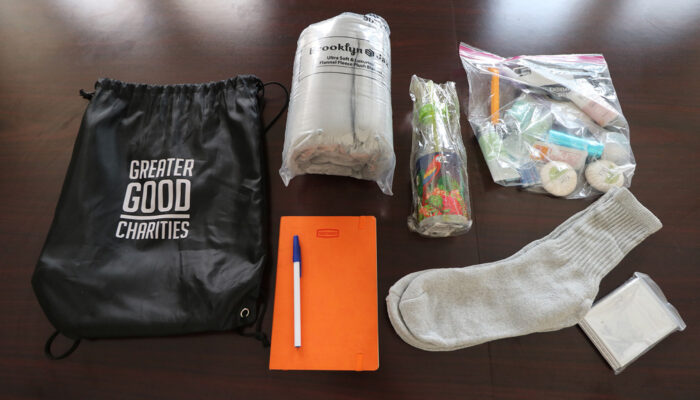
Nazar and Davis were also able to give the man one of the first Good Packs distributed to people living in the Forest Preserves. Provided to the Forest Preserves by Greater Good Charities through the volunteer-led Rescue Pack organization, the packs contain items meant to offer physical comfort and a pathway to support: flannel fleece and mylar blankets, socks, a water bottle, hygiene supplies, and a pen and notebook. As a local ambassador for Greater Good Charities, Rescue Pack helps bring national initiatives like Good Packs directly to communities across Illinois.
“It’s great for officers to have something they can hand someone who’s struggling,” said Davis. “It’s giving them something to help them in the future, something to remind them that people care about them.”
The Forest Preserves Landscape Maintenance staff, who also sometimes encounter unhoused people staying in the Preserves, are also trained to ensure those interactions are respectful and solution focused. Southwest Regional Superintendent Lisa Buczko leads the department’s efforts. She explained that field staff contact a supervisor first, who then brings police into the situation to ensure everyone’s safety.
From there, Landscape Maintenance may activate a long-standing partnership with the Alliance to End Homelessness in Suburban Cook County. Buczko works directly with Genea Moore, the Alliance’s outreach and lived experience engagement manager, who serves as a liaison between the Forest Preserves and multiple outreach organizations.
“She is the point person,” Buczko said. “We let her know the situation and location, and she connects us with an outreach coordinator for that area to come out and provide assistance.”
The Forest Preserves does still require individuals staying in the Preserves to leave, even if they don’t accept help. In these cases, staff ensure they are able to leave with their belongings. Other times, staff find belongings that indicate someone has been sleeping in the Preserves, but no individuals are present. Then staff leave a notice that the person has three days to leave. If the belongings remain after that, staff store the items securely for 30 days, leaving contact information so individuals can reclaim their only remaining possessions.
To Buczko, the work is rooted in empathy. “Something happened in their life that caused them to struggle,” she said. “You never know somebody’s story. It’s important to reassure them that help is available, that they are not alone and that there are resources that can get them back on their feet.”