
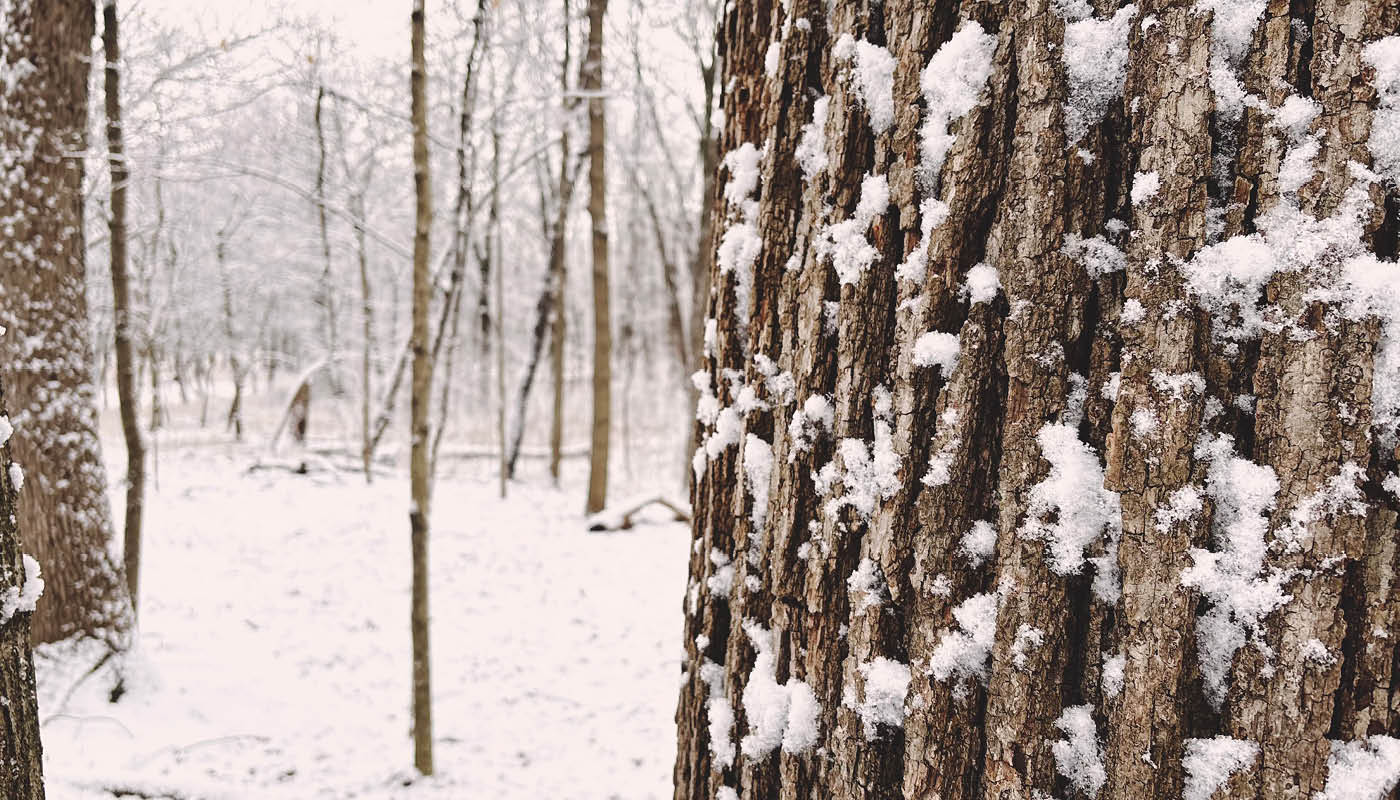
This winter, when the forest seems frozen in place and every sound carries farther than it should, you might hear a sharp crack echo through the woods. A breaking branch? A squirrel hopping from tree to tree? Most likely, it’s the trees themselves, reacting to the changing weather. It can be startling or even a little unsettling, but it is also a reminder that nature is resilient.
“Cook County has its average expected low temperatures, and the trees and plants in this area have adapted to the climate over millions of years,” says Nick Kuhn, a resource operations manager with the Forest Preserves. “While the trees growing here are built for cold, that does not mean winter is easy.” Extreme temperatures still test their limits and reveal just how dynamic these living structures really are.
Those sounds are often frost cracks, a phenomenon caused by rapid temperature changes. It all starts when the weather is much warmer. Trees pull moisture from the soil through the roots, sending it up the trunk. When the water reaches a tree’s leaves, it is released into the air through a process called transpiration.
Meanwhile, leaves also make food by converting sunlight into sugar, which travels back down into the tree to help nourish it. When trees drop their leaves in fall, that entire process slows to a crawl. “They’re going dormant,” Kuhn says. “They’re not transpiring water anymore.”
The sugars produced during the growing season are stored in the sap, which becomes thicker and more concentrated once water stops moving freely. That sugary sap acts like natural antifreeze, helping cells survive freezing temperatures. Thick bark adds another layer of insulation, while evergreen trees rely on waxy needles that limit moisture loss and protect from cold, dry air.
But the water that remains within trees come winter does what any water will when exposed to winter temperatures: It freezes. “Think about what happens when water freezes,” says Kuhn. “It expands. And if there’s enough pressure behind the bark, [that ice] breaks itself free.”
The result is a loud crack and a vertical split in the bark, usually a few inches to a couple of feet long. “It’s a slight bit of damage on a tree that it hopefully just recovers pretty quickly,” Kuhn says. Most trees do, carrying on with little more than a scar to show for the stress. Kuhn emphasizes that trees are remarkably resilient; even frost cracks or extended cold spells rarely spell disaster on their own.
“People shouldn’t worry if they see that or hear that,” he says. “They should just think, oh cool, I heard that.”