
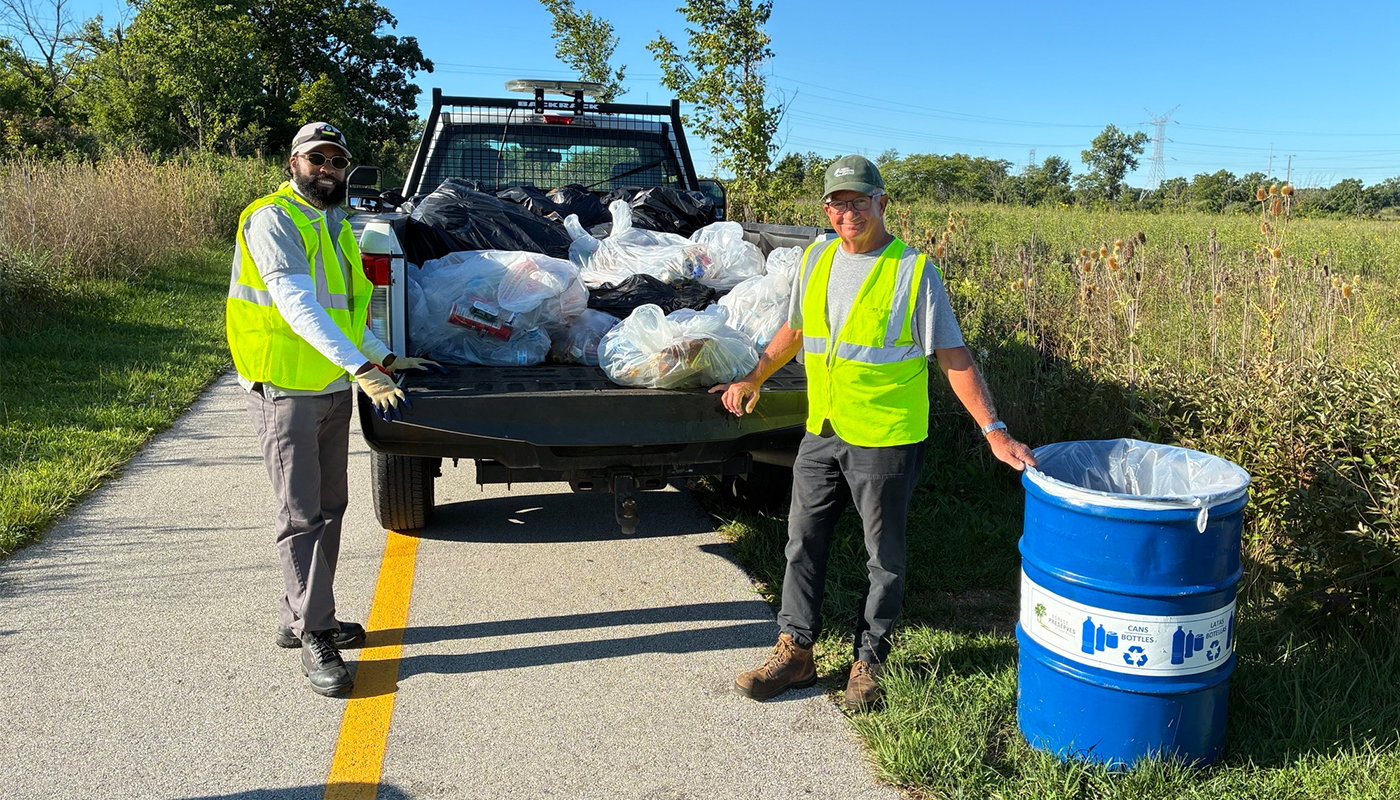
Simply moving where garbage cans are placed is making a big difference in the Forest Preserves of Cook County: Fewer overflowing bins, more time for crews to maintain the landscape, and natural spaces that are cleaner for people and wildlife. And all those benefits are happening while still providing plenty of places for the public to drop off trash during a visit.
The pilot program was launched last year because on any given morning, Forest Preserves Landscape Maintenance crews can find a trashy scene. At many locations, garbage cans and dumpsters overflow with trash. Mostly, it isn’t just leftovers from a visitor’s lunch. Some people drive to the parking lot to drop off their household and construction waste.
“For years it felt like our garbage system was basically a bring-your-house-garbage-here system,” says Landscape Maintenance supervisor Thomas Lyons about his experience at Tinley Creek. “We would dump a can, and by the next morning it would be filled with big bags of house garbage. And it wasn’t just a can or two. It was every can in every area.”
The problem went beyond inconvenience. Landscape Maintenance crews were spending hundreds of hours hauling garbage that wasn’t from visits to the Preserves, instead of caring for the land itself. And overflowing cans meant trash blowing across the land and animals ripping into bags of garbage.
Looking at practices used by neighboring forest preserve districts in DuPage and Will counties, Lyons noticed something important. Many didn’t put the garbage cans at the parking lot. Instead, bins were positioned where visitors were spending time using the site.
With support from leadership, Lyons proposed testing a similar idea in the Forest Preserves. The Tinley Creek division, which covers places like Tinley Park, Midlothian, Oak Forest and Palos Heights, became the pilot in July 2025. Crews reduced the overall number of garbage receptacles and moved the remaining ones out of parking lots and into shelters and along trails.
The results were immediate and dramatic. From July to December 2024, Tinley Creek collected 90 tons of garbage. After the pilot launched, during the same timeframe in 2025 the total was less than 50 tons. Crews spent more than 540 fewer hours driving garbage trucks and emptying bins, or less than half the time.
“It was like a ‘hallelujah’ moment,” Lyons says. “I was so pressed on this idea, and when we saw the results, it confirmed what we had been seeing in the field.”
As the pilot expanded to other busy divisions, the trend continued. In the Palos Division, which spans from Willow Springs to Lemont to Orland Park, garbage pick-up dropped from 7.7 tons in January 2025 to just 2.1 tons in January 2026, and staff hours spent on garbage collection fell 81 percent. At the Salt Creek Division, covering La Grange Park, Brookfield and Riverside, hours dropped nearly 77 percent. At Indian Boundary, which covers Schiller Park, River Grove and River Forest: 76 percent.
“The numbers don’t lie,” Lyons says. “It’s made everything so much more efficient.”
One concern at the start of the pilot was whether removing parking lot bins might lead to more littering, or people dropping off their household trash in the parking lot even without an available can. But that has not been the case. There haven’t been many complaints about the loss of parking lot cans, either.
“I really think a lot of these people are law-abiding citizens who were just doing it because a can was there,” he says.
The garbage reduction program is still expanding across divisions, but its early success is already reshaping how the Forest Preserves manages waste. And without overflowing bins attracting animals or blowing over in strong winds, less waste is spreading into forests, prairies and wetlands. Staff are able to focus more on mowing grass, setting up preserves for permitted events, cleaning up after them, installing new signs and so much more. “We’re not running garbage trucks every day,” Lyons says. “We’re able to put that time back into the preserves.”