
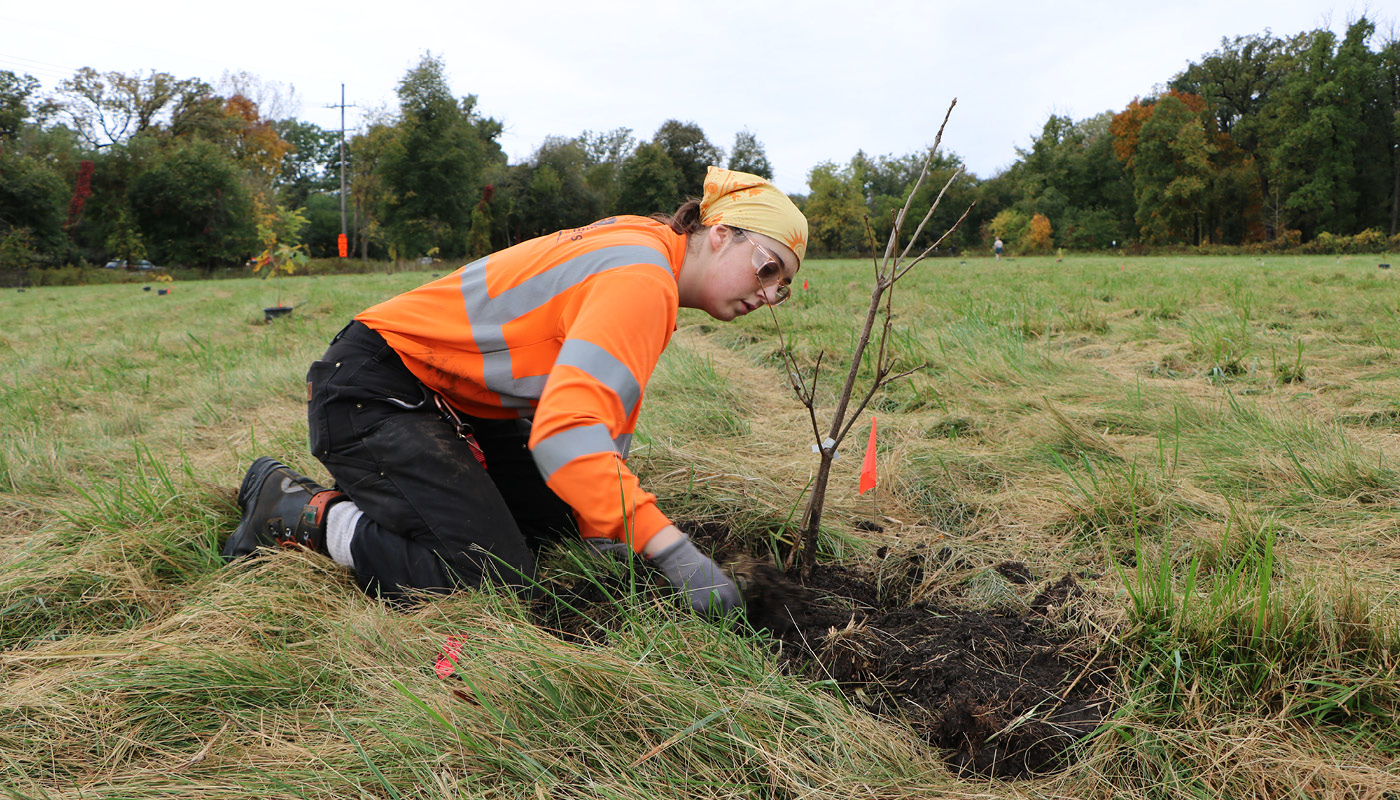
A tree doesn’t grow overnight. But at Harms Woods in Skokie, the Forest Preserves of Cook County is taking the first steps toward creating a forest that could thrive for generations.
A field once dominated by nonnative grasses is now home to nearly 150 young oak trees after ecologists with the Forest Preserves began an ambitious new reconstruction project. The goal? Transform the landscape into a rare type of woodland known as flatwoods, while giving ecologists an opportunity to study over decades how a forest develops from the ground up.
Located just west of the Illinois Holocaust Museum, Harms Woods sits alongside high-quality natural areas that offer a glimpse of what this landscape could eventually become.
“A reconstruction is pretty much like restoration from scratch,” said Iza Redlinski, deputy director of Resource Management for the Forest Preserves. “We’ve done a lot of prairie reconstructions, and we’ve done restoration in an existing woodland. But we haven’t done a woodland or a savanna reconstruction.”
Flatwoods have an unusual relationship with water. A thin layer of clay beneath the soil prevents water from draining easily, creating conditions that can leave the ground saturated in spring and fall but exceptionally dry during summer. These distinctive conditions support specialized plant communities, making flatwoods a rare and valuable part of Illinois’ natural heritage.
The newly planted oaks could eventually help recreate that habitat while providing an ecological buffer for the neighboring Harms Flatwoods Nature Preserve. As the trees mature, their expanding canopy will reduce sunlight reaching the nonnative grasses below, creating opportunities for woodland plants to establish themselves. The restored habitat could also provide additional space for wildlife already living in the adjacent preserves, including birds that require large stretches of woodland for nesting.
The story of these trees began in fall 2023, when acorns were collected from local oak trees. Those acorns spent the following two years growing at Chicago Botanic Garden before the young oaks were transferred to the Forest Preserves for continued care.
Each tree was planted with a tag and protected with a cage to prevent deer from feeding on its tender leaves and branches. Ecologists have also recorded the species and GPS location of each planting, allowing them to track individual trees as they grow.
The planting represents an opportunity to gather information that could shape future restoration projects throughout Cook County. Forest Preserves ecologists will monitor the trees’ growth and survival, studying how different oak species, including white oak, northern pin oak, bur oak, swamp white oak, red oak and pin oak, respond to the site’s conditions. The findings could help guide similar projects, including planned oak plantings at Bemis Woods. “We’re trying to see how this area that’s been heavily degraded reacts and what we can learn from it,” Redlinski said. “The Forest Preserves are for the long term. We are fantastic candidates for setting up long-term experiments or observations because we will be here in 100 years.”