

When Dr. Eliza Baker examines a wood duck in the Forest Preserves of Cook County, she’s not just looking at feathers and wings. She’s peering into the health of a species that tells a larger story about conservation, collaboration and the changing role of science in wildlife management.
“Wood ducks are an incredible species,” she says. “They’re the only native perching duck in Illinois. Despite being such an important species, there really has been no careful investigation of their health or whether some of their previous declines could have been due to poor health.”
For nearly 40 years, the Forest Preserves of Cook County has worked alongside the Illinois Department of Natural Resources to band and study these vibrant birds. The Forest Preserves bands birds as part of ongoing research that helps track ecosystem health, migration patterns and zoonotic diseases. Biologists safely capture, handle and band an average of 50 to 100 wood ducks, 70 different species and a total of 400 birds per year.
“They’re given a quota every year by U.S. Fish and Wildlife Service as to how many wood ducks and geese they have to band a year,” says Forest Preserves Senior Wildlife Biologist Chris Anchor. “Our wildlife team takes care of the ducks that get banded in Cook County.”
What makes today’s efforts different is the presence of a resident veterinarian like Baker. She joined the Illinois Zoological and Wildlife Health Management Residency in 2024 as part of a unique partnership with the University of Illinois, Brookfield Zoo Chicago and the Forest Preserves, designed to integrate veterinary medicine into wildlife field research.
“My goal is to become a state wildlife veterinarian or fulfill a similar role through a different position,” Baker explains. “After finishing my PhD, I felt like I had the research skills I would need in that role, but I wanted more hands-on, clinical experience with wildlife.”
Anchor says the veterinary wildlife residence program has elevated the research to a new level. “In addition to the birds being banded with a federal wildlife band, they’re also receiving a full veterinary workup to look at the overall health of all the ducks that we handle,” he says.
Baker describes her work as a kind of annual physical for wildlife. “We start by assessing body condition, hydration status and vital signs. We draw blood to perform a blood count and chemistry—very similar to the tests your doctor runs on you at an annual physical,” she says. “This can tell us about organ function, inflammation in the body and parasite burdens.”
She and her team then examine the ducks “from beak to feet, looking for any abnormalities.” In some cases, these examinations have revealed signs of viruses and other pathogens that could otherwise go undetected. “For example, there is a type of virus that can cause severe population impacts in ducks, and one of its clinical signs is crust or scabs underneath the tongue,” she notes. “You can imagine how easy to miss that would be if you didn’t know to look for it!”
As the data builds year over year, the veterinary component is already paying off. “The health data we provide for the wood duck population is meant to compliment the population level data that the biologists at the Forest Preserves and IDNR have been collecting for years,” Baker says. “The wellness exams give us a baseline of what is ‘normal’ for our wood duck population. Then, if we notice a change—either increases in certain pathogens or changes in organ values—we may be able to detect a problem before it starts causing population-level impacts.”
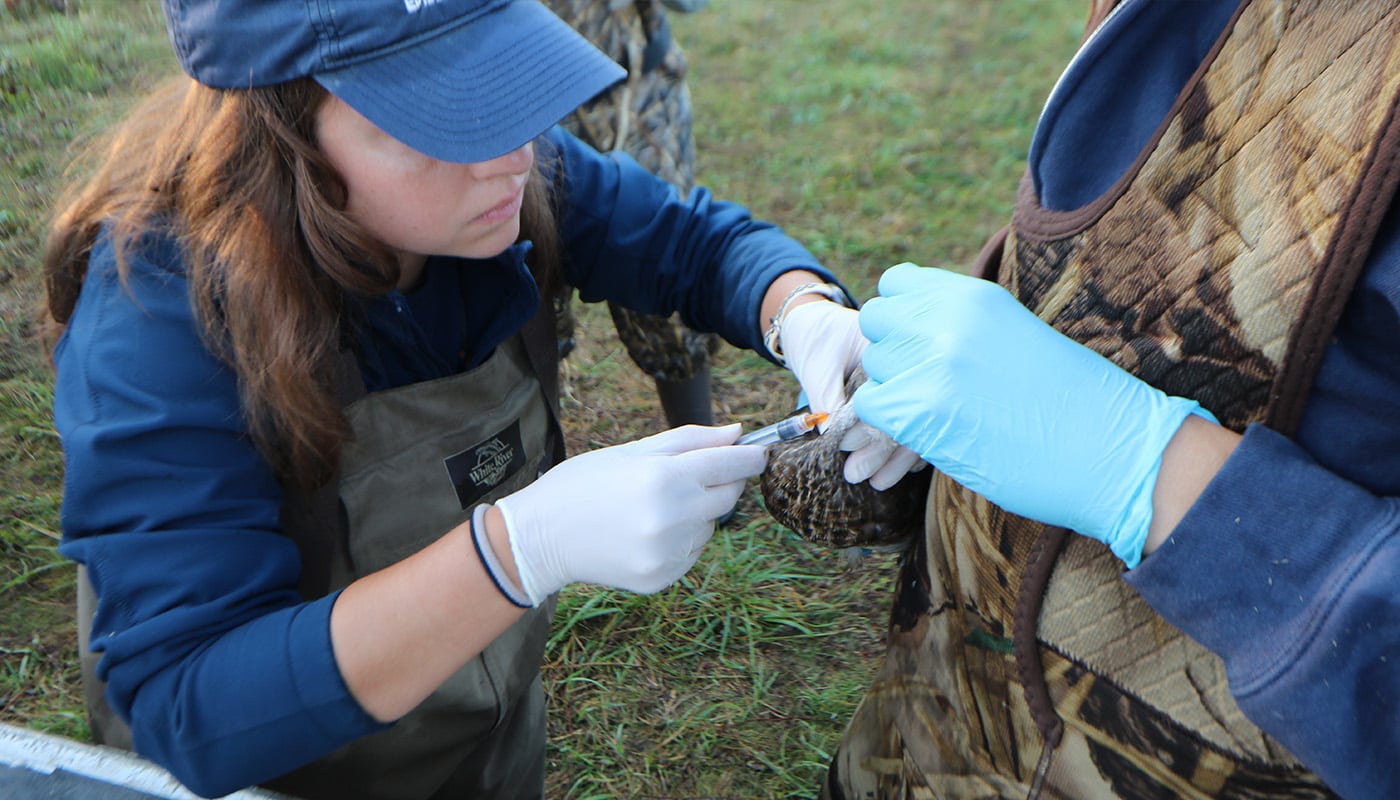
The combined effort now offers Cook County something few regions have—a decades-long record of both population trends and detailed health assessments for one of its key waterfowl species.
After nearly four decades, the Forest Preserves’ wood duck research continues to evolve from simple bands on legs to full medical checkups in the field. “What the vet residency program brings to the table,” Anchor says, “is a whole second level of understanding of the health of the animals and ultimately the health of the environment that we all have to share.”
The wood ducks of Cook County now serve as living indicators of ecosystem health and the progress of science itself. As Baker puts it, “Thankfully, our wood duck population appears overall healthy at this time; we are monitoring every year so that we can learn as much as possible about wood duck health and be prepared to act quickly if it changes.”